Microsoft developed the.NET Platform & Ecosystem as a software development environment for creating contemporary applications, including online, desktop, mobile, cloud, and gaming apps. Although it supports several programming languages, C# is the most popular. A wide range of frameworks, libraries, tools, and runtime components are available in the.NET ecosystem to assist developers in creating scalable and high-performing applications. Key technologies include Blazor for interactive online user interface, Entity Framework Core for data access, ASP.NET Core for web development, and.NET MAUI for cross-platform desktop and mobile apps.
All things considered, the.NET ecosystem makes it possible for developers to use a unified development strategy to effectively create and implement applications across many platforms.
What is.NET?
.NET is a software development platform developed by Microsoft that enables programmers to construct and execute a variety of programs, such as desktop software, mobile apps, cloud-based services, online applications, and APIs.
It offers:
An environment for running apps
A collection of libraries for typical programming tasks
Frameworks and tools to expedite development
Support for a variety of operating systems, including Linux, macOS, and Windows
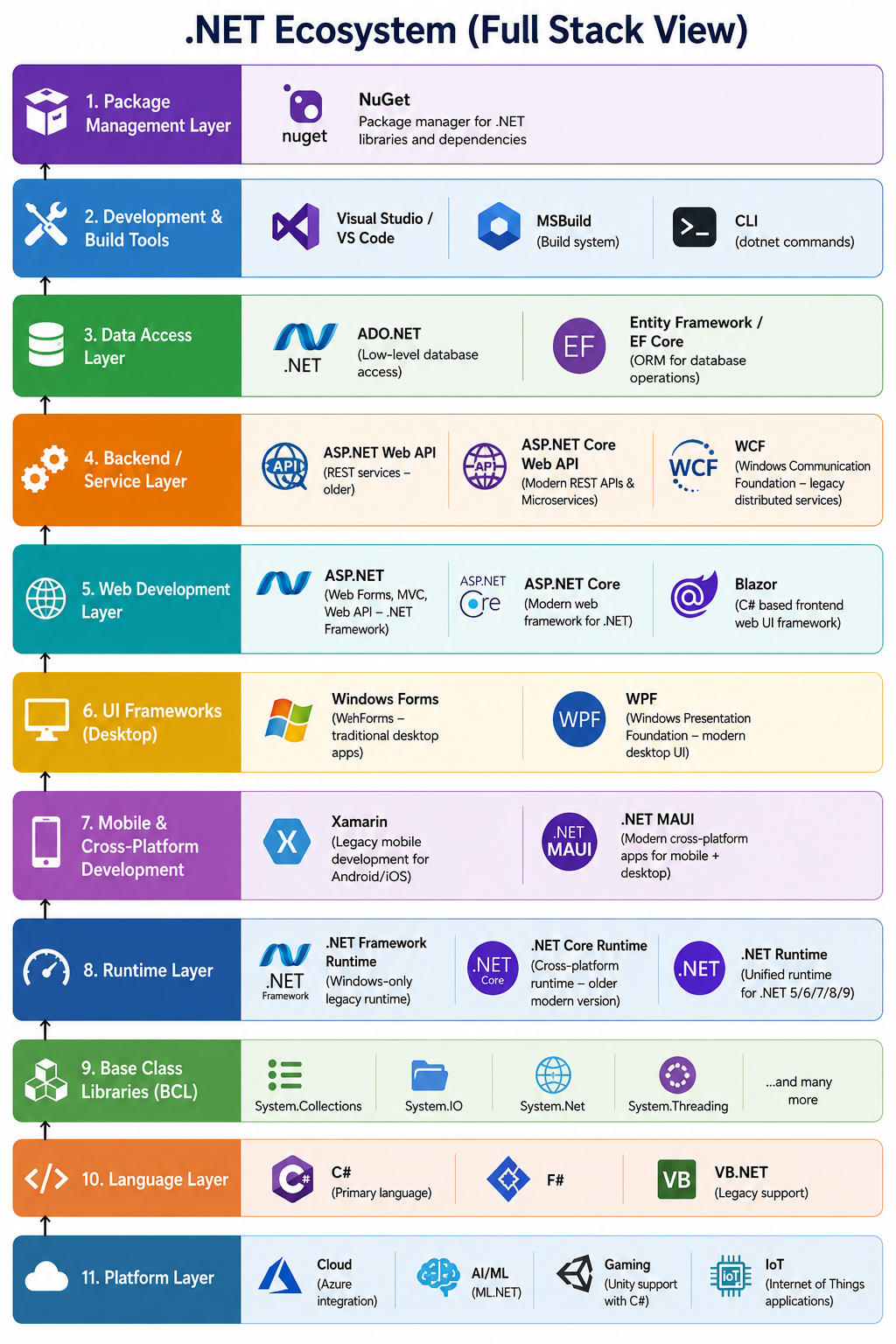
Now, we will explore and understand the complete web technologies in the .NET ecosystem.
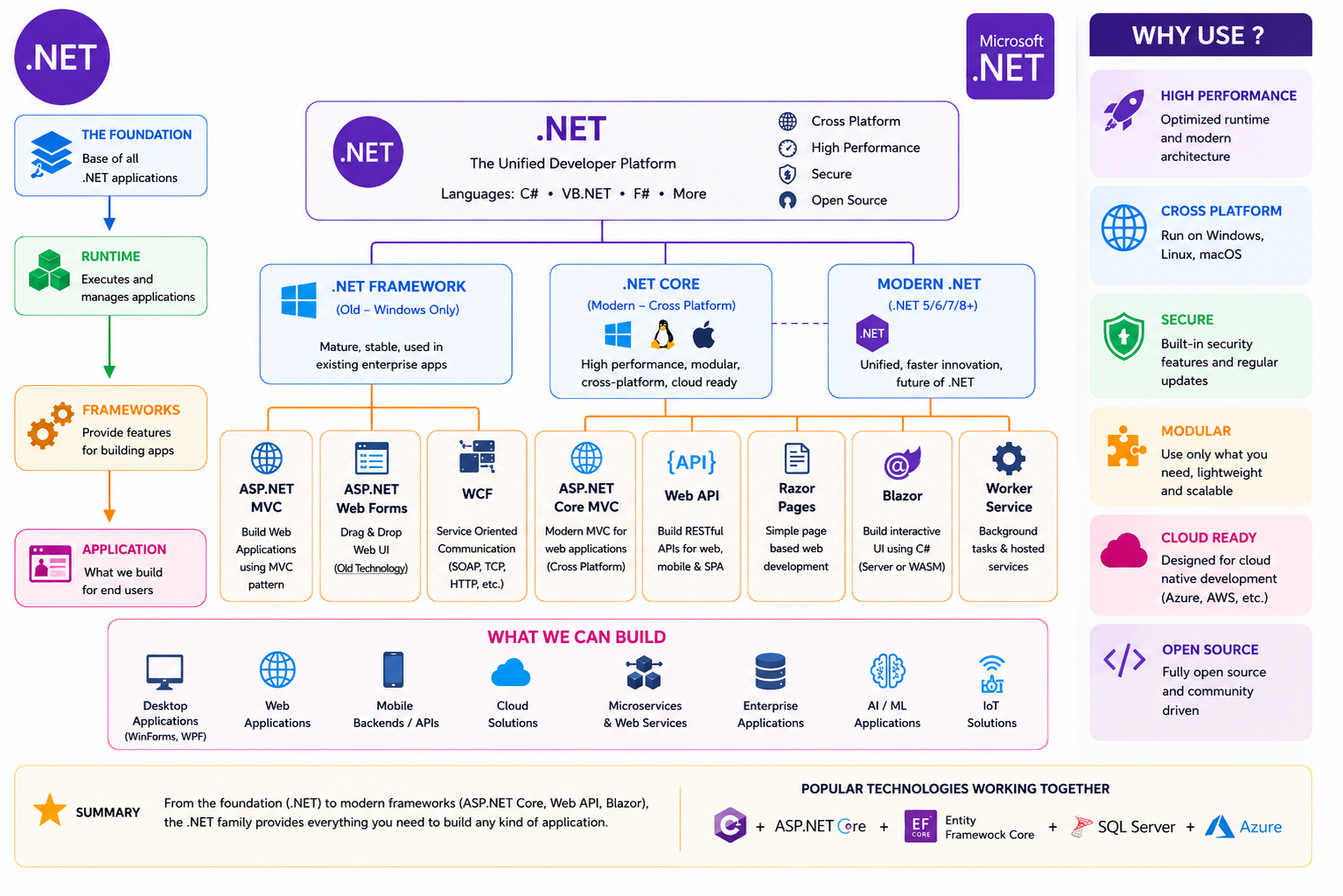
Types of .NET
1. .NET Framework
.NET Framework is the original Windows-only version of .NET introduced by Microsoft for building traditional desktop and web applications. It was mainly used with technologies such as ASP.NET, Windows Forms, WPF, and WCF for enterprise and Windows-based development.
2. .NET Core
.NET Core is a modern, lightweight, high-performance, and cross-platform version of .NET designed for modern application development. It supports Windows, Linux, and macOS, making it suitable for cloud applications, REST APIs, microservices, and containerized environments.
3. Modern .NET (.NET 5/6/7/8/9)
Modern .NET is the current unified platform that combines the best features of .NET Framework and .NET Core into a single ecosystem. It is used for building web applications, mobile apps, desktop software, cloud services, gaming applications, and AI-powered solutions.
Web Technologies in .NET
ASP (Active Server Pages)
ASP stands for Active Server Pages, an older server-side web technology introduced by Microsoft for creating dynamic web pages. It allowed developers to generate server-side content and build interactive websites before the introduction of the .NET platform.
Example:
A login page that dynamically validates a username and password using server-side VBScript.
ASP.NET (The Classic Framework)
Originally released in 2002, ASP.NET is the mature web framework designed for the Windows ecosystem. It runs on the full .NET Framework and is used to build dynamic websites, web applications, and web services.
ASP.NET provides technologies such as Web Forms, MVC, and Web API, allowing developers to build server-side applications using C# and the .NET Framework runtime.
Example:
An enterprise College management system built using ASP.NET MVC with SQL Server backend.
Types of ASP.NET
1. ASP.NET Web Forms
ASP.NET Web Forms is an event-driven framework used to build web applications using server controls and a drag and drop style development approach. It is mainly used in older enterprise applications.
Example:
A traditional school management system with form-based UI.
2. ASP.NET MVC
ASP.NET MVC is based on the Model-View-Controller architecture, providing better separation of concerns, maintainability, and control over HTML and routing. It is widely used for scalable web applications.
Example:
An e-commerce website like an online shopping portal.
3. ASP.NET Web API
ASP.NET Web API is used to build RESTful HTTP services that can be consumed by web, mobile, and desktop applications. It is mainly used for backend service development.
Example:
A mobile app backend that provides product data in JSON format.
4. WCF (Windows Communication Foundation)
WCF is a service-oriented communication framework in the .NET Framework used to build secure and distributed applications. It supports protocols like HTTP, TCP, MSMQ, and SOAP.
Example:
A banking system where multiple services communicate securely between departments.
ASP.NET Core (The Modern Redesign)
ASP.NET Core is a modern web development framework used with .NET Core and modern .NET (.NET 5/6/7/8/9). It is a complete redesign of ASP.NET, built for high performance, cloud-native applications, microservices, and cross-platform development.
It can run on Windows, Linux, and macOS.
Example:
A cloud-based API for food delivery apps like Swiggy or Zomato backend services.
Types of ASP.NET Core
1. ASP.NET Core MVC
ASP.NET Core MVC is the modern MVC framework used for building cross-platform web applications with clean architecture, dependency injection, and high performance.
Example:
A modern SaaS dashboard application.
2. ASP.NET Core Web API
ASP.NET Core Web API is designed for building fast, scalable RESTful APIs and microservices for cloud and frontend applications.
Example:
Backend service for a mobile banking application.
3. Razor Pages
Razor Pages is a simplified page-based framework in ASP.NET Core that makes web development easier by reducing complexity compared to MVC.
Example:
A simple blog or admin panel application.
4. Blazor
Blazor is a modern UI framework in ASP.NET Core that allows developers to build interactive web applications using C# instead of JavaScript.
Example:
A real-time chat application or interactive dashboard built entirely using C#.
5. Worker Service
A Worker Service is a type of application in modern .NET created by Microsoft that is used to run long-running background tasks without any user interface. It is mainly used for background processing like scheduled jobs, message queue handling, email sending, or continuous data processing and works well in cloud and container environments like Docker and Azure.
Example:
A Worker Service can be used in an e-commerce system to process order payments in the background once a user places an order, the service continuously checks the order queue and processes payment, updates inventory, and sends confirmation emails automatically without user interaction.
Conclusion
Web Technologies in .NET provide a complete evolution from classic ASP to modern ASP.NET Core, showing how web development in Microsoft has grown into a powerful, scalable, and cross-platform ecosystem. It enables developers to build everything from simple dynamic websites to high-performance cloud-based APIs and enterprise applications.
HostForLIFE.eu ASP.NET Core 10.0 Hosting
European best, cheap and reliable ASP.NET hosting with instant activation. HostForLIFE.eu is #1 Recommended Windows and ASP.NET hosting in European Continent. With 99.99% Uptime Guaranteed of Relibility, Stability and Performace. HostForLIFE.eu security team is constantly monitoring the entire network for unusual behaviour. We deliver hosting solution including Shared hosting, Cloud hosting, Reseller hosting, Dedicated Servers, and IT as Service for companies of all size.