Have you ever faced this problem?
Your SQL query runs in 100 milliseconds, but your C# API takes 2 or 3 seconds to give a response.
You check the database and think :
"The database is fast. So why is my API slow?"
This is a common problem in ASP.NET Core applications.
The database is only one part of an API request. There are many other things happening between the time a user sends a request and the time they get a response.
In this article, we will understand some simple and common reasons why a C# API can be slow even when the database query is fast.
First, understand what happens in an API
Suppose we have this API :
[HttpGet("orders")]
public async Task<IActionResult> GetOrders()
{
var orders = await _context.Orders
.ToListAsync();
return Ok(orders);
}
When a user calls this API, many things can happen:
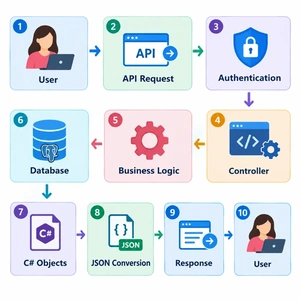
The database is only one step in this process.
So even if the database takes only 100 ms, another part of the application may be taking 2 seconds.
Let's look at some common reasons :
1. You are returning too much data
This is one of the easiest mistakes to make. Imagine your Customers table has 100,000 records.
You write:
var customers = await _context.Customers.ToListAsync();
return Ok(customers);
The database query might be reasonably fast.
But now your application has to:
- Read all the records.
- Create C# objects.
- Convert those objects into JSON.
- Send all that data to the client.
- That can take a lot of time.
A better approach , Only get the data you actually need.
var customers = await _context.Customers.Select(x => new
{
x.Id,
x.Name,
x.Email
})
.ToListAsync();
return Ok(customers);
Now you are not sending unnecessary columns.
2. Your API may be making many database calls
Your first query might be fast.
But what if your code runs that query 100 times?
For example:
foreach (var order in orders)
{
var customer = await _context.Customers
.FirstOrDefaultAsync(x => x.Id == order.CustomerId);
}
If you have 100 orders, you could end up making 100 extra database calls.
Each call may be fast. But together, they can make your API slow.
This problem is commonly called the N+1 query problem.
The simple lesson is:
- One fast query does not always mean a fast API.
- Always check how many database queries your API is actually making.
3. Entity Framework Core also needs time
Many C# applications use Entity Framework Core to work with databases.
When you run:
var users = await _context.Users.ToListAsync();
the work does not stop when SQL Server returns the data.
Entity Framework Core also needs to:
- Read the returned data.
- Create C# objects.
- Track those objects.
- Prepare them for your application.
- For read-only operations, you can sometimes use AsNoTracking():
var users = await _context.Users.AsNoTracking().ToListAsync();
This tells Entity Framework Core that you don't need to track these objects for changes.
For large read-only queries, this can reduce some unnecessary work.
4. JSON conversion can take time
Your API normally sends JSON to the client.
For example, your C# object:
new Customer
{
Id = 1,
Name = "John"
}
may become:
{
"id": 1,
"name": "John"
}
If you return thousands of records with many properties, converting all those objects to JSON can take time.
It also creates a larger response.
So the problem may not be the database.
It could be:
- Database → Fast
- C# processing → Slow
- JSON conversion → Slow
Network → Slow
5. Another API may be slowing you down
Sometimes your API calls another service.
For example:
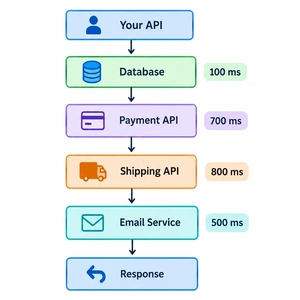
Your database is fast. But your complete API request is slow because it depends on other services.
This is very common in real-world applications.
6. Business logic can also take time
Suppose your API gets data from the database and then performs a lot of processing :
var orders = await GetOrders();
foreach (var order in orders)
{
// Complex calculations
// Price calculation
// Discount calculation
// Tax calculation
}
The database may take only 100 ms. But your C# code could take another 1 or 2 seconds.
This is why you should measure the complete API, not only the SQL query.
7. How do you find the real problem?
Don't guess. Measure the different parts of your API.
For example :
var stopwatch = Stopwatch.StartNew();
var orders = await _context.Orders
.AsNoTracking().ToListAsync();
stopwatch.Stop();
_logger.LogInformation(
"Database call took {Time} ms",
stopwatch.ElapsedMilliseconds);
Now you can see how long the database operation took from the application's point of view.
You can also measure other parts of your code.
For example:
|
Process
|
Time
|
|
Database
|
100 ms
|
|
Business Logic
|
900 ms
|
|
JSON Conversion
|
600 ms
|
|
External API
|
800 ms
|
|
Total Time
|
2400 ms (2.4 seconds)
|
Now you have a much better idea of where the problem is.
A simple real-world example :
- Imagine an e-commerce application.
- A customer opens the My Orders page.
- The API takes 3 seconds.
- The developer checks SQL Server:
- SQL Query = 80 ms
They think:
"The database is not the problem." Then they check the API.
They discover :
They discover :
|
Process
|
Time
|
|
Database
|
80 ms
|
|
Customer Lookup
|
400 ms
|
|
Product Lookup
|
700 ms
|
|
JSON Conversion
|
600 ms
|
|
Other Processing
|
500 ms
|
|
Network
|
300 ms
|
|
Total Time
|
~2580 ms (2.58 seconds)
|
Now the problem is much clearer.
The SQL query itself was fast. The API was slow because of the other work happening around the query.
What should you check when your C# API is slow?
When debugging a slow API, check these things:
- How many database queries are being executed?
- Are you loading more data than necessary?
- Are you using AsNoTracking() for read-only queries where appropriate?
- Are you making calls to other APIs?
- Is your C# business logic taking too much time?
- Is JSON serialization taking too much time?
- Is the response very large?
- Is the network slow?
- Are middleware or authentication steps taking time?
Final thoughts , A slow API does not always mean a slow database.
Your API is a complete process:
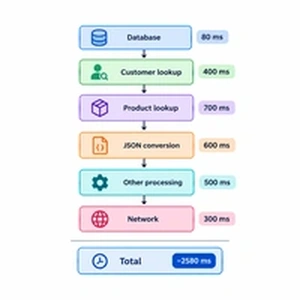
The database is only one part of that process. So the next time someone says:
"The SQL query is fast, but the API is slow."
Don't immediately optimize the SQL query.
First, measure the complete request and find where the time is actually being spent. Measure first. Find the slow part. Then optimize it.
Conclusion
A slow API is not always caused by the database. Identify performance bottlenecks, optimize queries, and avoid unnecessary processing to make your API faster and more efficient.
HostForLIFE.eu ASP.NET Core 11.0 Hosting
European best, cheap and reliable ASP.NET hosting with instant activation. HostForLIFE.eu is #1 Recommended Windows and ASP.NET hosting in European Continent. With 99.99% Uptime Guaranteed of Relibility, Stability and Performace. HostForLIFE.eu security team is constantly monitoring the entire network for unusual behaviour. We deliver hosting solution including Shared hosting, Cloud hosting, Reseller hosting, Dedicated Servers, and IT as Service for companies of all size.